
Views: 0 Author: Site Editor Publish Time: 2026-01-23 Origin: Site


One loose clamp can turn a minor fault into an overnight outage. Wind, vibration, and salt air expose every weak connection on the pole.
In this article, we explain how customized Pole Line Hardware meets harsh power distribution demands. You’ll learn what to specify for load, corrosion, fit, and compliance, so crews install faster and lines stay stable longer.
Pole Line Hardware covers parts that hold systems together. It includes bolts, bands, clamps, brackets, and washers. They connect crossarms to poles and keep joints steady. They hold insulators in place through heat and vibration. They restrain cables and grounding leads during storms. They keep loads where engineers expect them.
Many systems still use inch-based hardware. Many projects also follow recognized standards. For example, IEEE’s C135 series addresses pole line hardware and testing practices. Knowing this scope helps buyers write clear specs and avoid mismatched parts.
Pole Line Hardware is not “small stuff” in the field. It is the first line of defense against slippage and drop hazards. A loose connection can arc and damage nearby components. Crews then face emergency repairs and longer outages.
Hardware affects maintenance cycles across pole populations. Many utilities inspect poles on multi-year cycles. Surveys often cite 8–10 years for inspection intervals. So hardware must stay stable between checks. Better fit and coating reduce service calls and truck rolls. That improves reliability outcomes and project economics.
Rigour often depends on corridor conditions and asset mix. Coastal routes face salt spray and constant wetting. Urban poles carry power and telecom attachments. Each add-on raises wind area and vibration.
Rigorous demand also means tight outage windows. They need parts that align fast and torque predictably. If a band does not match pole diameter, they fight the fit. If edges are sharp, they slow down. Custom Pole Line Hardware targets these pain points before the truck rolls.
Note:Harsh exposure plus long inspection cycles raise the real risk cost.
Customization starts from loads, not from drawings alone. Buyers should define tension, shear, and bending drivers first. We often see line motion drive fatigue, not static overload. So designs need margin for vibration and peak events.
A good spec includes the load case, the safety factor, and the failure mode to avoid. For clamps and bolts, buyers may ask for proof or ultimate loads. IEEE also publishes standards focused on mechanical testing and acceptance for load-rated line hardware. These references help align factory tests and field expectations.
Material is a lever buyers pull fast. Low-carbon steel suits many formed fittings. Forged steel fits high-load clamps and critical bolts. 304 stainless suits corrosive corridors and wet zones.
Environment | Common choice | Why it works | Watch-outs |
Normal inland distribution | Carbon steel + HDG | Cost and durability balance | Define A153 class, inspect |
Coastal / high humidity | 304 stainless or enhanced HDG | Strong corrosion resistance | Check galvanic pairs |
High-load clamping points | Forged steel + HDG | High toughness, high load | Verify proof tests |
Tip:Pick material after you map exposure, loads, and access limits.
Hot-dip galvanizing remains the default for Pole Line Hardware. ASTM A153 covers hot-dip zinc coatings for many hardware items and fasteners. It sets expectations for coating quality and minimum thickness by product category.
Buyers should treat “galvanized” as a starting word, not a spec. Ask for coating targets in microns and a verification plan. In some atmospheres, an 85 μm coating can provide decades of protection. One UK guidance note cites long life potential under typical exposures (needs verification for your region).
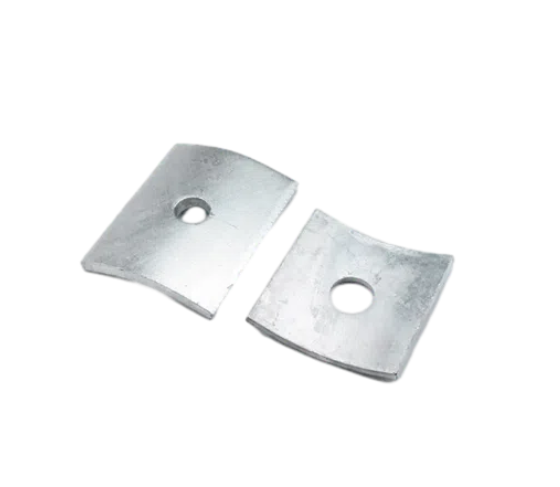
Fit errors create hidden costs during installs. A washer that misses curvature concentrates stress in one line. A band that is off diameter can twist under torque. A bracket hole mismatch forces field drilling and rework.
Customization can be simple and valuable for teams. You can match a washer radius to the pole profile. You can adjust offset distances for mixed attachments. You can also control tolerances for repeatable alignment. These moves improve load distribution and reduce loosening over time. It also helps crews avoid field drilling on treated poles.
Field crews care about the install, not the CAD. Rounded edges reduce glove cuts and snagging hazards. Clean chamfers help bolts start faster under poor lighting. Consistent wrench flats reduce rounding during high-torque field work. These details shorten install time during tight outage windows.
Customization can also support standard tools and methods. Buyers can specify head styles and clearance needs. They can request pre-assembled kits for common builds. It reduces missed parts and rework during live-line constraints. They also help crews keep torque consistent across shifts daily.
Traceability helps utilities manage multi-site Pole Line Hardware. Laser marks can carry part IDs and batch codes. They speed repairs and simplify recalls when issues appear.
Customization lever | What to specify | Business benefit |
Load rating | Proof load and safety factor | Lower failure risk |
Coating system | Standard and micron target | Longer corrosion life |
Geometry | Pole diameter, radius, holes | Faster installs |
Finish and safety | Edge radius, deburr, threads | Safer handling |
Marking | Part ID and batch code | Better traceability |
They also support warranty discussions, since you can trace parts back to lots.
High performance starts at joint stability. Vibration can back off nuts and shift bands. So designs need bearing area and stable clamping force. Curved washers can spread load on round poles. Proper forming also avoids sharp stress risers.
Buyers focus on repeatable torque behavior in crews’ hands. Threads should run clean under dry and wet torque. Surfaces should not bind under load cycles. For critical fittings, routine acceptance testing can confirm performance. IEEE’s testing guidance helps align pass criteria across suppliers.
It matters during every storm event.
Outdoor exposure is relentless across most utility territories. Rain cycles promote under-film corrosion near edges. Salt air accelerates zinc loss and pits exposed cut edges. Industrial zones add acids and soot on surfaces. So coating choice must match exposure, not just price.
ASTM A153 is widely used for small parts and fasteners. It sets coating requirements and finish expectations for hot-dip zinc on hardware. When buyers specify it clearly, they reduce ambiguity in quotes and inspections.
We recommend salt-spray targets in RFQs for coastal projects.
Dimensional accuracy is a performance feature for crews. It reduces install time and crew frustration. It also reduces joint slip risk. If holes are off, loads shift into bending. It can shorten service life and increase emergency callouts.
A capable supplier controls incoming steel, forming dies, and gauges. They track tolerances across lots to keep every install predictable. Buyers should request first-article checks for custom parts. They should also approve fit on a real pole section before scaling.
Tip:Request a first-article report before you approve full production volume.
Global projects mix standards in practice. Many utilities reference IEEE C135 standards for pole line families. IEEE notes C135.90 covers inch-based wood pole line hardware used in overhead construction. Other C135 standards address test practices for load-rated hardware.
Some tenders also cite ANSI C135 items for specific fasteners. Buyers should list the documents in the RFQ. They should also clarify the governing unit system and tolerances. Clear inputs reduce back-and-forth during approval. They may also include local GB rules for regional builds.
For galvanized Pole Line Hardware, verify three core items early. First, confirm the coating standard, such as ASTM A153. Second, confirm the coating thickness category for your parts. Third, define the inspection method and sampling.
Industry guidance explains ASTM A153 coating thickness depends on product category and thickness. It also highlights finish requirements and special handling of threaded areas. These notes prevent disputes during incoming inspection.
Ask how they measure thickness on edges, flats, and threads today. Set an AQL sampling plan, then confirm calibration for gauges too.
Documentation builds trust and speeds approvals in utilities. Ask for material certificates and coating verification records. Ask for dimensional inspection records on custom geometry. For load-rated items, ask for test reports tied to the lot.
Document | What it proves | When you need it most |
Material certificate | Grade and heat trace | New supplier setup |
Coating record | Standard and thickness | Harsh environments |
Dimensional report | Holes and curvature fit | Retrofits |
Mechanical test | Proof results | Load-rated items |
Keep certificates in one folder, so auditors and crews find them fast during outages too.
New builds move fast under schedules and budgets. Reconductoring often moves even faster under outage limits. Crews need parts that fit and torque cleanly. Custom Pole Line Hardware can match pole class and attachment geometry. It reduces drilling and improvisation in the field.
Reconductoring can also increase mechanical loads on structures. Higher ampacity may mean larger conductors and higher tension. That pushes demand into clamps, bolts, and bands. A tailored load spec helps avoid weak links during upgrades. It reduces warranty disputes later, too. It keeps crews on schedule during storms.
Coastal networks pay a real corrosion tax each year. Salt attacks zinc and exposed steel fast in service. Stainless options can make sense for selected fittings. Enhanced galvanizing targets can also help. Buyers should consider mixed assemblies and galvanic pairing risk.
Some sources note coating life scales roughly linearly with thickness in similar exposure. So a thicker, verified coating can buy time. Still, local conditions vary a lot by microclimate. Treat life estimates as guidance, not a warranty (needs verification).
Stainless can cut rust risk in splash zones.
Shared poles are common in modern corridors and towns. They carry power, fiber, and street lighting. This creates clearance and interference risks at attachments. Offset hoops and custom brackets help manage spacing. They also keep loads balanced on the pole.
Retrofits often face legacy hole patterns and mixed bolt sizes. Custom hardware can adapt to those patterns and reduce pole damage. It also reduces time spent on field modifications. That protects safety and reduces claims across contractors. We often see custom offsets prevent clashes between power and fiber runs today.
Rural networks face long travel times and limited crews. So reliability matters more than elegance in design. Hardware should resist loosening and corrosion for long periods. It should also support simple inspection and replacement tasks.
Many utilities assume wood poles serve for decades, often 30–40 years. Many also inspect poles every 8–10 years in practice. Hardware must survive a large slice of that period. Better coatings and fit reduce mid-life rework and emergency calls.
It lowers truck rolls, since sites may sit hours away.
A strong RFQ shortens the full timeline for buyers. Send drawings or a physical sample when possible. Add pole type, diameter range, and mounting constraints. Add the standards list and unit system. Add the corrosion zone and expected service life.
Also include your acceptance plan for inspection. Tell suppliers how you will measure coating thickness. Tell them what reports you expect per shipment. It saves time and prevents scope gaps during approval. Include pole photos and a simple bill of materials. State inspection points, so they plan production checks early.
Samples should prove fit and function, not just appearance. Start using a pilot lot for validation. Test it on a pole section in shop. Check crew feedback on handling and torque. Then lock the spec and gauge plan.
For load-critical hardware, align sampling to test requirements. IEEE’s testing standards describe routine acceptance testing for load-rated line hardware. Use them to define sampling and pass criteria.
Run a torque-and-fit trial during the pilot lot review. If needed, perform corrosion checks after packing and handling.
Look for process control, not marketing slogans. A good supplier shows incoming material checks and traceability. They show in-process sampling and final inspection steps. They can also show calibration records for gauges. These signals predict stable quality during scale.
Ask how they handle nonconforming parts in production. Ask for a corrective action workflow and timelines. A supplier who explains it clearly usually runs tighter lines. That reduces field risk and protects project schedules. Ask who owns the QC plan and sign-offs. They should show CAPA timing and closure rates.
Customization still has business constraints for procurement teams. Tooling, dies, and coating batch sizes affect MOQ. Lead time depends on sampling, approvals, and production queues. Packaging also matters for long bands and coated edges. Bent bands and chipped zinc create claims.
Align logistics early in the RFQ stage. Decide on pallet patterns and carton labeling rules. Decide on port, incoterms, and inspection points. These steps keep schedules stable during grid upgrades. Confirm minimum runs per SKU before you consolidate freight today. Ask about carton drop tests for long-distance transit risk.
Customized Pole Line Hardware lowers field risk fast. It improves fit, load control, and corrosion life. It also supports standards and clear traceability, so crews work safer and outages drop over time.
Hangzhou Wonder Hardware Manufacturing Co., Ltd. provides OEM and ODM Pole Line Hardware for demanding projects. They offer HDG, 304 stainless, and forged options, helping buyers match pole geometry and specs, so builds move faster and hardware lasts longer outdoors.
A: Pole Line Hardware includes clamps, bands, bolts, and brackets that secure lines and insulators.
A: Customized Pole Line Hardware improves fit, reduces loosening, and boosts long-term reliability.
A: Choose Pole Line Hardware using HDG specs or 304 stainless, and require coating proof.
A: Pole Line Hardware often aligns with IEEE C135 and ASTM A153, plus project requirements.
A: Pole Line Hardware issues often come from wrong pole diameter, curvature, or hole patterns.


